
Telehealth Is The Next Frontier For Outer Cape Health
by Andy Kirkaldy
BREWSTER – At a community conversation at Brewster Town Hall Monday, Outer Cape Health Services CEO Damian Archer explained and took questions about why there will be more telehealth medical care offered to patients of the nonprofit’s healthcare centers in Harwich Port, Wellfleet and Provincetown.
As he had in earlier community conversations in Wellfleet and Provincetown, Archer focused on telehealth’s role in serving patients well while also protecting the future of the Outer Cape Health Services (OCHS) clinics.
Archer said those centers provide care to about “one in five” residents of the 10 outermost Cape Cod towns they serve.
How will telehealth help OCHS thrive and actually serve more patients?
Archer said OCHS’s federally supported community health centers have a combined wait list of about 1,000 patients seeking primary medical care, some waiting for months or even years. Adding more telehealth appointments could reduce that backlog, he said, while OCHS can more easily hire health care professionals who often prefer working remotely from their homes.
Archer said a remote nurse job advertised in May 2025 drew 157 applicants, 75 in the first week. Typically, he said, for non-remote nursing positions, “We might get a hit every three to six months.” For a full-time remote primary care provider opening in February, OCHS in the first week received eight applications, and by April 28 17 had applied. Archer said it typically takes a year or two to hire a primary care provider.
The twin goals of cutting the waitlist and increasing the staff, according to Archer at the community meetings and in an interview with The Chronicle, can be met without compromising patient care and while still offering onsite appointments when necessary or preferred by patients.
At Brewster Town Hall on Monday, Archer called the wait list of patients “a core issue” that he and the nonprofit’s health centers’ board hope OCHS can address by offering more telehealth options.
“The people who are waiting for care are the ones I worry about the most,” he said.
Archer emphasized telehealth will not replace in-person visits, but rather be an option that will expand OCHS’s ability to serve patients.
“Our goal is to supplement in-person care with other options for our patients to get with us, and if patients prefer to visit in person, they will be able to do that,” he said.
One goal of the community meetings, Archer said, was to prepare patients to hear about remote appointments from their OCHS providers.
“What we are doing with these conversations is [to say] please expect that our clinicians might say, ‘Hey, why don’t we try telehealth next visit?’” he said.
Archer spoke to a combined total of about 100 live and online attendees in Wellfleet on April 8 and Provincetown on April 11. In Brewster, three town residents showed up at town hall and 15 people attended remotely, and Archer fielded several questions.
He was asked if someone has a bad cough and needed further in-person care, possibly to check the patient for pneumonia, could the remote visit transition in-person.
Archer said telehealth has been practiced widely and improved since the beginning of the COVID-19 pandemic, and the OCHS teams of four that work together — a primary care clinician, two nurses (one part-time) and a medical assistant — have such contingencies covered.
“We’ve had now six years of experience of how to do that safely,” he said. “ This is where it turns back to the clinical team to do the appropriate amount of triaging… All through the process we’re listening and determining, ‘Is this appropriate for telehealth or not?’” A current OCHS patient asked what might change. Archer said nothing was likely to change immediately, unless by her preference.
“At some point it might be faster for you to be seen online or with your clinician for telehealth than it would be in person,” he said. “And all that will be driven by what is the medical necessity, the thing you need to be seen for…Is it something that could be fully and completely done remotely or must be done in person, like there is a physical exam that needs to be done, like we can’t suture a wound online.”
He added at the Wellfleet session, “The most important part of your diagnosis is the history that you take from the patient, listening to what happened, when it happened, how it happened. Then the examination and the testing is to confirm what you think the patient has.”
The Brewster resident also asked if telehealth was done by phone call or an internet video connection.
Archer said he expected most patients had the ability and hardware, possibly with the help of an OCHS technician, to handle “high-quality video telehealth to the greatest degree possible…unless there was a patient request to use the phone.”
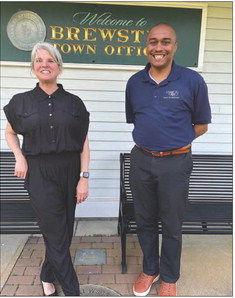
Outer Cape Health Services CEO Damian Archer, right, and Director of Development Irene Hammer on Monday in Brewster completed the third of three Community Conversations explaining why the health nonprofit will be emphasizing more telehealth appointments to its patients. ANDREW KIRKALDY PHOTO
Outer Cape Health
In a followup question, Archer was asked how OCHS could help people who didn’t have or couldn’t afford hardware for telehealth. Archer said there were also patients who for a number of reasons lacked the ability to operate the hardware or participate in remote calling. He said if more patients choose the telehealth option, “It gives us more space to see those people” who simply can’t use telehealth.
Archer added that OCHS “digital navigators” could help other patients get grant funding and/or other nonprofit agencies to help provide patients with laptops if needed.
A resident also asked Archer if patients could truly develop trust in and create solid relationships with caregivers over remote video and not just see “a face on the screen.”
He responded that the telehealth clinicians have been screened for the ability to establish relationships during the hiring process. Training is ongoing, and “virtual only” therapy for mental health purposes has become widely practiced, accepted and successful.
Increasing telehealth will not happen right way, Archer said. He described it as like OCHS “building a plane as we fly it.” OCHS will have to invest in personnel and equipment.
The price tag? It is estimated at $2 million, Archer said.
“If there is any grant out there with telehealth on it, we’ve already applied,” Archer said.
As well as primary care providers, OCHS will need to bring aboard technicians, front desk workers and the digital navigators to support patients and clinicians, he said.
“High quality telehealth comes with a whole team of people,” he said.
As costly as the transition might be, Archer said failing to invest in telehealth would be a mistake given the current fiscal and political climate, which includes cuts to Medicaid, a major source of OCHS’s revenue.
“If we don’t do this, with all the things going on around us, it’s actually going to get a lot worse very quickly,” Archer said. “So we don’t really have much of a choice but to innovate and improve.”
The upside? Archer said the move toward telehealth could be good news for OCHS patients and centers.
“I firmly believe fulfilling the mission of the health center will allow us to win the day, he said.”